
In this article, you’ll find the full ship stats, building costs, and Artifact hull details currently available in The Citadel. The tables below are designed to make direct comparison easier, whether you’re looking for the fastest interceptor, the toughest sentinel, a mining-focused hauler, or simply the hull that best fits your preferred playstyle. I’ve also added sorting and filtering to the main stats table, so you can narrow the list down by role or fitting options instead of scanning every ship manually. Below the tables, I’ll share a few observations and patterns that became much easier to spot once all 20 hulls were placed side by side.
Please note: The Citadel entered its first beta playtest in September 2026 and is still in active development. Ship stats, blueprint costs, Artifact bonuses, and other values may change at any time. If you spot an incorrect or outdated value, please contact me through the site contact form, leave a comment below the article, or send me a DM on the official The Citadel Discord at @sturmer.one.
Table of Contents
Ship Roles at a Glance
Before diving into the full stat table, it helps to understand what each role is trying to do. The Citadel’s ship classes are not just labels — their hardpoints, mobility, durability, sensors, and fitting space follow some very clear patterns.

- Scout — The lightest and most agile hulls. Scouts have excellent acceleration, high speed, small signatures, and strong sensor range, but give up armor, hull strength, and fitting space. They are built for mobility, reconnaissance, and getting in or out quickly rather than standing their ground.
- Interceptor — A more combat-focused take on mobility. Interceptors remain fast and agile, usually with strong propulsion capacity, but gain more armor and weapon hardpoints than Scouts. They are well suited for aggressive movement, chasing targets, and skirmishing.
- Destroyer — The most balanced combat hulls in the current roster. Destroyers combine solid armor, respectable mobility, four Battery hardpoints, and enough fitting space to support a wide range of builds. They are the closest thing The Citadel currently has to a general-purpose combat class.
- Sentinel — Heavy defensive ships aka tanks, built around durability. Sentinels carry the highest armor values in the standard roster, along with strong hull and heat capacity, but sacrifice acceleration, turn rate, and propulsion flexibility. They are clearly designed to stay in the fight rather than outrun it.
- Artillery — Long-range weapon platforms, the glass canons. Their defining feature is five Battery hardpoints, supported by the longest sensor range in the current lineup. In return, they have limited Subsystem and Propulsion options, making them much more specialized than Destroyers.
- Support — Utility-focused hulls with strong Subsystem capacity and better heat management than most classes. Their raw combat stats or mobility are less extreme, but their fitting layout suggests they are intended to amplify builds through modules rather than brute force.
- Hauler — Heavy industrial ships with the largest Core Slot counts and the highest mass. They are slower to accelerate and turn, with large signatures, but offer exceptional fitting and cargo-oriented potential. Their higher thrust helps move all that mass, though they still feel more like flying workshops than dogfighters. I find them the most interesting to play around and tinker something unusual.
All The Citadel Ship Stats
I’ve collected the current characteristics of every ship into one sortable table and added filters to make comparison a little easier. You can sort individual stats, narrow the list by ship role, or filter by Battery, Subsystem, and Propulsion hardpoints when looking for a hull that fits a particular build. Later, I also plan to add a proper layout calculator here — that part is still a work in progress, so stay tuned.
| Ship ▲▼ | Role ▲▼ | PR ▲▼ | Armor ▲▼ | Hull ▲▼ | Heat Cap. ▲▼ | Heat Diss. ▲▼ | Mass ▲▼ | Thrust ▲▼ | Accel. ▲▼ | Turn Accel. ▲▼ | Turn Rate ▲▼ | Velocity ▲▼ | Sensor ▲▼ | Signature ▲▼ | Battery ▲▼ | Subsystem ▲▼ | Propulsion ▲▼ | Core Slots ▲▼ |
|---|---|---|---|---|---|---|---|---|---|---|---|---|---|---|---|---|---|---|
| Acolyte | Support | 2,310 | 2,000 HP | 600 HP | 550 GJ | 5 /s | 4 T | 130 N | 76.8 m/s² | 65.3 °/s² | 27.2 °/s | 307 m/s | 4.5 km | 3.4 km | 3 | 4 | 2 | 20 |
| Achamoth | Hauler | 2,666 | 2,400 HP | 800 HP | 500 GJ | 4.5 /s | 5.8 T | 150 N | 61.1 m/s² | 42.7 °/s² | 17.8 °/s | 265 m/s | 5 km | 4.7 km | 3 | 3 | 4 | 24 |
| Augr | Hauler | 2,738 | 2,520 HP | 800 HP | 500 GJ | 4.5 /s | 5.8 T | 150 N | 61.1 m/s² | 42.7 °/s² | 17.8 °/s | 251 m/s | 5 km | 4.7 km | 3 | 4 | 2 | 26 |
| Beltane | Interceptor | 2,340 | 1,700 HP | 400 HP | 450 GJ | 4.5 /s | 4 T | 140 N | 81.8 m/s² | 68 °/s² | 28.3 °/s | 321 m/s | 4 km | 3 km | 4 | 2 | 4 | 19 |
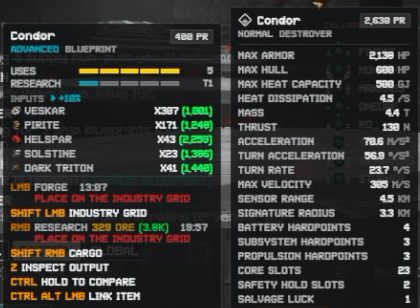
| Condor | Destroyer | 2,630 | 2,130 HP | 600 HP | 500 GJ | 4.5 /s | 4.4 T | 130 N | 70.6 m/s² | 56.9 °/s² | 23.7 °/s | 305 m/s | 4.5 km | 3.3 km | 4 | 3 | 3 | 23 |
| Eidolon | Scout | 2,150 | 1,650 HP | 375 HP | 425 GJ | 5.5 /s | 3.6 T | 130 N | 91.8 m/s² | 73.6 °/s² | 30.7 °/s | 342 m/s | 5 km | 2.5 km | 3 | 2 | 4 | 18 |
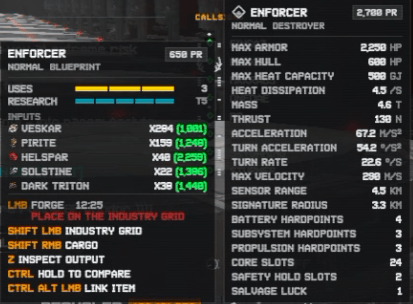
| Enforcer | Destroyer | 2,708 | 2,250 HP | 600 HP | 500 GJ | 4.5 /s | 4.6 T | 130 N | 67.2 m/s² | 54.2 °/s² | 22.6 °/s | 290 m/s | 4.5 km | 3.3 km | 4 | 3 | 3 | 24 |
| Jackal | Interceptor | 2,270 | 1,663 HP | 400 HP | 450 GJ | 4.5 /s | 3.9 T | 140 N | 85.9 m/s² | 71.4 °/s² | 29.8 °/s | 337 m/s | 4 km | 3 km | 4 | 2 | 4 | 18 |
| Legion | Destroyer | 2,630 | 2,250 HP | 600 HP | 500 GJ | 4.5 /s | 4.4 T | 130 N | 70.6 m/s² | 56.9 °/s² | 23.7 °/s | 290 m/s | 4.5 km | 3.3 km | 4 | 3 | 3 | 23 |
| Mammon | Hauler | 2,880 | 2,400 HP | 800 HP | 500 GJ | 4.5 /s | 6.1 T | 150 N | 58.2 m/s² | 40.6 °/s² | 16.9 °/s | 265 m/s | 5 km | 4.7 km | 3 | 4 | 2 | 27 |
| Orstrog | Artillery | 2,420 | 2,200 HP | 600 HP | 475 GJ | 4.5 /s | 4.5 T | 135 N | 70.3 m/s² | 54.5 °/s² | 22.7 °/s | 283 m/s | 5.4 km | 3.2 km | 5 | 2 | 2 | 21 |
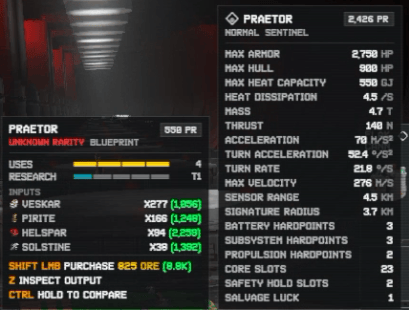
| Praetor | Sentinel | 2,426 | 2,750 HP | 900 HP | 550 GJ | 4.5 /s | 4.7 T | 140 N | 70 m/s² | 52.4 °/s² | 21.8 °/s | 276 m/s | 4.5 km | 3.7 km | 3 | 3 | 2 | 23 |
| Roc | Sentinel | 2,426 | 2,750 HP | 945 HP | 570 GJ | 4.5 /s | 5 T | 140 N | 66.6 m/s² | 49.9 °/s² | 20.8 °/s | 276 m/s | 4.5 km | 3.7 km | 3 | 3 | 2 | 23 |
| Rune | Interceptor | 2,270 | 1,638 HP | 400 HP | 450 GJ | 4.5 /s | 3.9 T | 140 N | 85.9 m/s² | 71.4 °/s² | 29.8 °/s | 305 m/s | 4 km | 3 km | 4 | 2 | 4 | 18 |
| Scarab | Destroyer | 2,560 | 2,250 HP | 630 HP | 525 GJ | 4.5 /s | 4.6 T | 130 N | 67.2 m/s² | 54.2 °/s² | 22.6 °/s | 290 m/s | 4.5 km | 3.3 km | 4 | 3 | 3 | 22 |
| Seraph | Interceptor | 2,200 | 1,750 HP | 400 HP | 450 GJ | 4.5 /s | 3.9 T | 140 N | 85.9 m/s² | 71.4 °/s² | 29.8 °/s | 321 m/s | 4 km | 3 km | 4 | 2 | 4 | 17 |
| Skoll | Scout | 2,220 | 1,650 HP | 375 HP | 425 GJ | 5.5 /s | 3.7 T | 130 N | 87.4 m/s² | 70.1 °/s² | 29.2 °/s | 342 m/s | 5 km | 2.5 km | 3 | 2 | 4 | 19 |
| Starrk | Support | 2,380 | 2,000 HP | 630 HP | 570 GJ | 5 /s | 4.2 T | 130 N | 73.1 m/s² | 62.2 °/s² | 25.9 °/s | 307 m/s | 4.5 km | 3.4 km | 3 | 4 | 2 | 21 |
| Typhon | Sentinel | 2,496 | 2,750 HP | 900 HP | 550 GJ | 4.5 /s | 5 T | 140 N | 66.6 m/s² | 49.9 °/s² | 20.8 °/s | 276 m/s | 4.5 km | 3.7 km | 3 | 3 | 2 | 24 |
| Vektr | Artillery | 2,420 | 2,200 HP | 600 HP | 475 GJ | 4.5 /s | 4.8 T | 135 N | 66.9 m/s² | 52 °/s² | 21.6 °/s | 283 m/s | 5.4 km | 3.2 km | 5 | 2 | 2 | 21 |
There are already several interesting patterns hiding in these numbers, including some very clear role identities and a few ships that look unusually strong — or suspiciously weak — when compared directly with their closest alternatives. I’ll get into those in the Insights section below.
Artifact Ships: Names, Abilities and Bonuses
The Citadel currently has 20 different base ships, and each hull also has an Artifact — effectively the game’s legendary version of that ship. Artifact ships come with unique abilities that can significantly reinforce or even reshape the role of the original hull. Some lean harder into damage, others improve survivability, mining, mobility, or more specialized mechanics. They also carry four additional stat modifiers: three positive bonuses and one drawback. Those can vary heavily between Artifact hulls, so I’ve included them separately where the data is available.
P.S. I’m still missing some of the Artifact data despite being very focused on burning through crafting and blueprint purchases. Yes, this scientific operation continues despite the TZHALs’ repeated attempts to eliminate my peaceful research program. But if you already own one of the missing Artifact ships, please send me a screenshot of its stats — ideally including the final four modifiers shown on the hull. That will help complete the table much faster.
| Base Ship | Role | Artifact Name | Special Ability | Modifier 1 | Modifier 2 | Modifier 3 | Modifier 4 (negative) |
|---|---|---|---|---|---|---|---|
| Orstrog | Artillery | ??? | ??? | ??? | ??? | ??? | ??? |
| Vektr | Artillery | ??? | ??? | ??? | ??? | ??? | ??? |
| Condor | Destroyer | Praedo | Turret Damage rises up to +35% with the worth of the target, full at 15,000. Missile Damage rises up to +35% with the worth of the target, full at 15,000. | ??? | ??? | ??? | ??? |
| Enforcer | Destroyer | ??? | ??? | ??? | ??? | ??? | ??? |
| Legion | Destroyer | ??? | ??? | ??? | ??? | ??? | ??? |
| Scarab | Destroyer | ??? | ??? | ??? | ??? | ??? | ??? |
| Achamoth | Hauler | ??? | ??? | ??? | ??? | ??? | ??? |
| Augr | Hauler | Dvergr | Each completed mining zone adds +8% Mining Speed, up to 10 stacks. All stacks drop 10s after the last one. | ??? | ??? | ??? | ??? |
| Mammon | Hauler | ??? | ??? | ??? | ??? | ??? | ??? |
| Beltane | Interceptor | ??? | ??? | ??? | ??? | ??? | ??? |
| Jackal | Interceptor | ??? | ??? | ??? | ??? | ??? | ??? |
| Rune | Interceptor | ??? | ??? | ??? | ??? | ??? | ??? |
| Seraph | Interceptor | ??? | ??? | ??? | ??? | ??? | ??? |
| Eidolon | Scout | ??? | ??? | ??? | ??? | ??? | ??? |
| Skoll | Scout | Solvarg | +15% Max Speed in the Optimal Heat Zone. +20% Turret Damage in the Optimal Heat Zone. | Max Repair Amount +31.2% | Max Heat Capacity +31.1% | Tracking Speed +25.1% | Turret Range −23.4% |
| Praetor | Sentinel | ??? | ??? | ??? | ??? | ??? | ??? |
| Roc | Sentinel | ??? | ??? | ??? | ??? | ??? | ??? |
| Typhon | Sentinel | Tempestas | Below 50% Armor, lightning hits the 5 nearest enemies within 10 km for 3s (90s cooldown). Below 50% Armor, repairs 25% of Max Armor over 30s (90s cooldown). | ??? | ??? | ??? | ??? |
| Acolyte | Support | ??? | ??? | ??? | ??? | ??? | ??? |
| Starrk | Support | ??? | ??? | ??? | ??? | ??? | ??? |
Ship Building Costs
All material costs in the table below are shown for standard Normal blueprints, giving us a clean baseline for comparing every ship. Higher-quality blueprints increase those requirements:
- Advanced (blue): +10%
- Prototype (epic): +20%
- Artifact (legendary): +50%
Depending on how far you’ve developed your Forge, some of that additional cost can be offset by crafting bonuses, so the final amount you personally spend may be lower than the raw blueprint requirement.
| Ship | Role | Veskar | Pirite | Helspar | Solstine | Dark Triton |
|---|---|---|---|---|---|---|
| Orstrog | Artillery | 220 | 73 | 41 | 80 | 0 |
| Vektr | Artillery | 146 | 115 | 27 | 33 | 34 |
| Condor | Destroyer | 279 | 155 | 39 | 21 | 37 |
| Enforcer | Destroyer | 204 | 159 | 40 | 22 | 30 |
| Legion | Destroyer | 418 | 234 | 59 | 32 | 0 |
| Scarab | Destroyer | 260 | 151 | 38 | 21 | 36 |
| Achamoth | Hauler | 151 | 201 | 44 | 94 | 0 |
| Augr | Hauler | 112 | 117 | 26 | 55 | 33 |
| Mammon | Hauler | 134 | 141 | 30 | 66 | 39 |
| Beltane | Interceptor | 182 | 99 | 102 | 13 | 32 |
| Jackal | Interceptor | 99 | 94 | 91 | 12 | 32 |
| Rune | Interceptor | 99 | 94 | 91 | 12 | 32 |
| Seraph | Interceptor | 144 | 138 | 143 | 18 | 0 |
| Eidolon | Scout | 203 | 137 | 46 | 69 | 0 |
| Skoll | Scout | 140 | 94 | 32 | 47 | 31 |
| Praetor | Sentinel | 277 | 166 | 94 | 38 | 0 |
| Roc | Sentinel | 183 | 110 | 63 | 25 | 34 |
| Typhon | Sentinel | 190 | 113 | 64 | 26 | 35 |
| Acolyte | Support | 197 | 301 | 32 | 38 | 0 |
| Starrk | Support | 136 | 207 | 22 | 26 | 33 |
Overall, ship construction costs are quite manageable. With a dedicated mining ship and a bit of focused gathering, most hulls don’t take particularly long to assemble.

There’s also another interesting pattern hidden in the material requirements: the cost itself often gives you a rough idea of where a ship sits within its class. More expensive hulls tend to represent a higher step within the same role, and in several cases the material spread helps reveal that progression even before you compare the raw stats.
And that brings us to the most interesting part of the guide — the patterns, oddities, and balance observations hiding across the full ship roster.
Ship Insights and Balance Observations
Once all 20 ships are placed side by side, The Citadel’s internal ship design becomes much easier to read. Most hulls follow a surprisingly consistent logic: classes share recognizable fitting layouts, while individual ships trade armor, mobility, heat capacity, and Core Slots against one another. A few ships, however, stand out immediately.

Core Slots look like one of the game’s main balancing currencies
Core Slots scale very neatly across the roster:
- Seraph — 17
- Eidolon, Jackal, Rune — 18
- Beltane, Skoll — 19
- Acolyte — 20
- Orstrog, Vektr, Starrk — 21
- Scarab — 22
- Condor, Legion, Praetor, Roc — 23
- Achamoth, Enforcer, Typhon — 24
- Augr — 26
- Mammon — 27
That progression looks deliberate. It also helps explain several ships that can look weaker if you compare only armor, speed, or handling. In many cases, the compensation comes through extra fitting space.
Mammon is the clearest example. It is the most expensive standard hull in the current roster at 2,880 PR, yet it is also the heaviest Hauler at 6.1 T, has the lowest acceleration in its class at 58.2 m/s², and shares the same 2,400 Armor and 800 Hull as Achamoth. What Mammon gets instead is 27 Core Slots, the highest value of any standard ship. That strongly suggests fitting flexibility is treated as a major source of power.
Condor and Legion are a clean example of a proper sidegrade
Condor and Legion both sit at 2,630 PR, and most of their stats are identical. Legion has 2,250 Armor, while Condor has 2,130 Armor. Condor, however, reaches 305 m/s, while Legion tops out at 290 m/s.
Everything else is effectively the same: 600 Hull, 500 GJ Heat Capacity, 4.4 T mass, 70.6 m/s² acceleration, 56.9°/s² turn acceleration, 23.7°/s turn rate, 4.5 km sensor range, 3.3 km signature, 4/3/3 hardpoints, and 23 Core Slots.
That is a very readable trade-off: Legion is tougher, Condor is faster, and neither completely invalidates the other, which is actually good!
Starrk and Acolyte follow the same pattern
Starrk costs 2,380 PR, compared with Acolyte at 2,310 PR.
For those extra 70 PR, Starrk gains:
- 630 Hull vs 600
- 570 GJ Heat Capacity vs 550
- 21 Core Slots vs 20
But it also becomes heavier and less agile:
- 4.2 T vs 4.0 T
- 73.1 vs 76.8 m/s² acceleration
- 62.2 vs 65.3°/s² turn acceleration
- 25.9 vs 27.2°/s turn rate
Both still reach exactly 307 m/s.
That makes Starrk another good example of a genuine sidegrade. You gain fitting space, Hull, and heat capacity, while Acolyte remains the more responsive ship. At the same time, Starrk has a particularly convenient Subsystem layout: its four Subsystem hardpoints make it much easier to fit larger three-slot modules without awkward compromises elsewhere in the build.
The Sentinel trio shows three different priorities
Praetor, Roc, and Typhon all share the same basic Sentinel identity: 2,750 Armor, 3 Battery / 3 Subsystem / 2 Propulsion, 4.5 km sensor range, and 3.7 km signature radius.
Praetor is the most agile of the three:
- 4.7 T
- 70.0 m/s² acceleration
- 52.4°/s² turn acceleration
- 21.8°/s turn rate
Roc is heavier at 5.0 T and drops to 66.6 m/s² acceleration, 49.9°/s² turn acceleration, and 20.8°/s turn rate, but gains:
- 945 Hull vs 900
- 570 GJ Heat Capacity vs 550
Praetor and Roc even share the same 2,426 PR, so this is another clean sidegrade: mobility versus durability and heat capacity.
Typhon is more unusual. It uses Roc’s heavier handling profile — 5.0 T, 66.6 m/s² acceleration, 49.9°/s² turn acceleration, 20.8°/s turn rate — but keeps Praetor’s lower 900 Hull and 550 GJ Heat Capacity.
Its compensation is fitting space: 24 Core Slots instead of 23. Typhon also costs more at 2,496 PR. So here the game appears to value one additional Core Slot highly enough to justify both a PR (Power Rating) increase and weaker raw stats compared with Roc.
Scarab looks unusually efficient for its PR
Scarab is the cheapest Destroyer at 2,560 PR, below Condor and Legion at 2,630 and Enforcer at 2,708.
Yet it carries:
- 2,250 Armor
- 630 Hull
- 525 GJ Heat Capacity
That gives Scarab the joint-highest Armor among the Destroyers, the highest Hull, and the highest Heat Capacity. But its disadvantages are:
- 22 Core Slots, compared with 23 on Condor and Legion and 24 on Enforcer
- heavier/slower handling at 4.6 T, 67.2 m/s² acceleration, and 22.6°/s turn rate
That still looks like a very strong package for the PR cost. If your build does not desperately need the extra fitting space, Scarab may be one of the best-value combat hulls in the current roster.
Rune versus Jackal is difficult to justify on paper
Rune and Jackal both cost 2,270 PR and share almost everything:
- 400 Hull
- 450 GJ Heat Capacity
- 4.5/s Heat Dissipation
- 3.9 T mass
- 140 N thrust
- 85.9 m/s² acceleration
- 71.4°/s² turn acceleration
- 29.8°/s turn rate
- 4 km sensor range
- 3 km signature radius
- 4/2/4 hardpoints
- 18 Core Slots
Yet Jackal has 1,663 Armor, compared with Rune at 1,638. More importantly, Jackal reaches 337 m/s, while Rune reaches only 305 m/s. A 25-point Armor difference is tiny. A non-boosted 32 m/s top-speed advantage is not. Based purely on the visible hull stats, Jackal is simply the stronger ship for exactly the same PR. That does not necessarily mean Rune is pointless, but nothing in the current stat table explains the trade-off.
Orstrog versus Vektr is even more suspicious
Orstrog and Vektr both cost 2,420 PR and share:
- 2,200 Armor
- 600 Hull
- 475 GJ Heat Capacity
- 4.5/s Heat Dissipation
- 135 N thrust
- 283 m/s velocity
- 5.4 km sensor range
- 3.2 km signature radius
- 5 Battery / 2 Subsystem / 2 Propulsion
- 21 Core Slots
The differences all favor Orstrog:
- 4.5 T vs 4.8 T
- 70.3 vs 66.9 m/s² acceleration
- 54.5 vs 52.0°/s² turn acceleration
- 22.7 vs 21.6°/s turn rate
Vektr does not gain anything elsewhere in the visible stats. So, at least on paper, Orstrog is a direct upgrade for the same PR. This is probably the clearest balance oddity in the current ship roster. Yes, there are building costs, but it is so tiny.
Haulers are not a simple upgrade ladder
The three Haulers look similar at first, but their stat spreads point toward different priorities.
Achamoth sits at 2,666 PR with 24 Core Slots, 4 Propulsion hardpoints, and 265 m/s velocity.
Augr rises to 2,738 PR and gains:
- 2,520 Armor vs 2,400
- 26 Core Slots vs 24
But it drops to 2 Propulsion hardpoints and 251 m/s.
Mammon pushes fitting space furthest at 27 Core Slots and costs 2,880 PR, but it is also the heaviest and least agile of the three at 6.1 T, 58.2 m/s² acceleration, and 16.9°/s turn rate.
So the Haulers do not read as cheap → better → best. They look more like three different industrial philosophies:
- Achamoth — mobility and propulsion flexibility
- Augr — tougher, more fitting-heavy
- Mammon — maximum fitting capacity
The class structure itself is very consistent
Hardpoint layouts are almost class signatures.
- Interceptors: 4 / 2 / 4
- Destroyers: 4 / 3 / 3
- Sentinels: 3 / 3 / 2
- Artillery: 5 / 2 / 2
- Scouts: 3 / 2 / 4
That means most differentiation within a class comes from Armor, Hull, heat, mobility, signature radius, and Core Slots rather than completely different fitting layouts. This is actually good design for readability. Once you understand a class, comparing hulls inside it becomes much easier.
Overall balance looks coherent — with a few exceptions
Most ships in The Citadel are not simple upgrades. The roster usually trades durability, mobility, fitting space, heat capacity, and specialization against one another in fairly predictable ways. That is why the questionable cases stand out so clearly.
- Rune looks statistically weaker than Jackal for the same PR.
- Vektr appears to lose mobility to Orstrog without gaining anything in return.
- Scarab, on the other hand, may be getting a little too much durability and heat capacity for its relatively low PR.
Everything here is based on the current beta values, and those can obviously change. There is also one major part of ship balance I have not properly covered yet: the physical module layouts themselves.
Those layouts can completely change how useful a hull feels in practice, even when the raw stats look competitive. Acolyte is a good example. Its Support role sounds flexible on paper, but the actual layout is quite gimmicky. In practice, you are heavily pushed toward repair beams and single-slot drone controllers, with much less freedom than the stat sheet initially suggests. For that level of restriction, I would personally expect stronger compensation through mobility or a smaller target profile. If a Support ship is forced into such a narrow layout, it should at least be especially good at repositioning and staying out of trouble and its wont be too OP since you cant pack it with rack of railguns and kite things around.
Sentinels raise a similar question for me. They give up roughly a quarter of their potential DPS compared with more aggressive combat hulls, yet the defensive gain is only around 300 effective HP. In the current combat environment, that can amount to just one or two extra volleys. Personally, I would push Sentinels much further into true flying brick territory. If they are meant to sacrifice damage for survivability, then that survivability should be immediately noticeable in a fight rather than disappearing in another second or two of concentrated fire.
That could also help address what currently feels like a very glass-cannon-heavy meta. It is easy to build ships pushing around 600 DPS, where fights can end extremely quickly. I would like to see combat last long enough for positioning and environmental tools to matter more: using trains, pulling friendly NPCs into a fight, retreating behind structures, or making tactical decisions instead of simply watching a target evaporate under concentrated damage.
The current ship roster already shows a strong balancing philosophy (esp compared to Alpha builds), but layouts and real combat behavior add another layer that the raw numbers cannot capture. That is probably where some of the most interesting balance questions still remain.
If you’re interested in where I think The Citadel could push its ship and faction design further, I also put together a full Seyra faction concept built around asymmetric warfare, mobility, and battlefield control.
Sources Gallery







Leave a Reply